If Openness is about the breadth of a person's engagement with the world, Conscientiousness is about the depth of their self-regulation within it. It captures the degree to which a person organizes their impulses, plans their behavior, honors their commitments, and follows through.
The research on this trait is striking. Conscientiousness is the single strongest personality predictor of long-term physical health. Conscientious people stick to health habits, show up for check-ups, moderate their vices. It likely predicts long-term financial success too, for the same reason: these are people who pay off debts, maintain savings plans, and push consistently toward goals. The compounding effect of that consistency, over a lifetime, is enormous. Conscientiousness is “one of the best indicators of long-term adaptive success” (Furnham et al, 2014). The data backs that up.
What It Looks Like in Real Life
Meet Avital. She's your sister-in-law, a family physician, and the person who makes everyone else in the family feel slightly disorganized. Her medical bag has a designated pocket for everything. When her kids were small, their school forms were filed before the school year started. She once noticed that your car registration had expired before you did. She doesn't say anything about it, exactly. She just mentions it, in passing, in the way she mentions everything, as a fact that clearly needed to be said. She is warm, she is funny, she shows up when you need her. There is a steadiness to her that you have come to rely on in a way you don't always admit. When something goes wrong in the family, Avital is the one who already knows what to do, not because she's bossy, but because she has, at some point, quietly thought through what to do if this ever happened.
Meet Eitan. Eitan is 36 and brilliant. He's a creative director at a design agency, full of ideas, fast on his feet, and genuinely fun to work with. He often needs reminders for internal deadlines because he gets absorbed in something new before the previous thing is finished. His workspace is covered with layers of paper representing different phases of different projects. He once solved a client problem in a ten-minute hallway conversation that the team had been stuck on for a week. His manager has quietly learned to pad every deadline she gives him by four days.
Avital is high in Conscientiousness. Eitan is low. Every good organization needs both of them, but they need to be matched to the right parts of the work.
The Sub-Facets
Competence - confidence in one's ability to handle what life brings; high scorers walk into situations prepared
Order - the need for organization and structure in the environment
Dutifulness - a strong sense of moral obligation to follow through on commitments
Achievement striving - the drive to push toward goals and meet high personal standards
Self-discipline - the ability to begin and complete tasks despite distraction or boredom
Deliberation - thinking carefully before acting; the opposite of impulsiveness
People low in Conscientiousness aren't lacking in all of these equally. Some are highly competent but poorly organized. Some have strong achievement drive but low self-discipline. The sub-facets matter, which is another reminder that we're always dealing with a specific profile unique to every individual, not overarching large categories.
The 2x2: When Openness Meets Conscientiousness
Here is one of the most practically useful frameworks in this entire series. We never want to view a person through the light of individual personality traits. A person is more than the sum of each of the big five traits. We are an interaction of each of our different traits.
When you cross Openness and Conscientiousness, you get four meaningfully different personality profiles, and recognizing which quadrant someone occupies tells you a great deal about how to work with them.
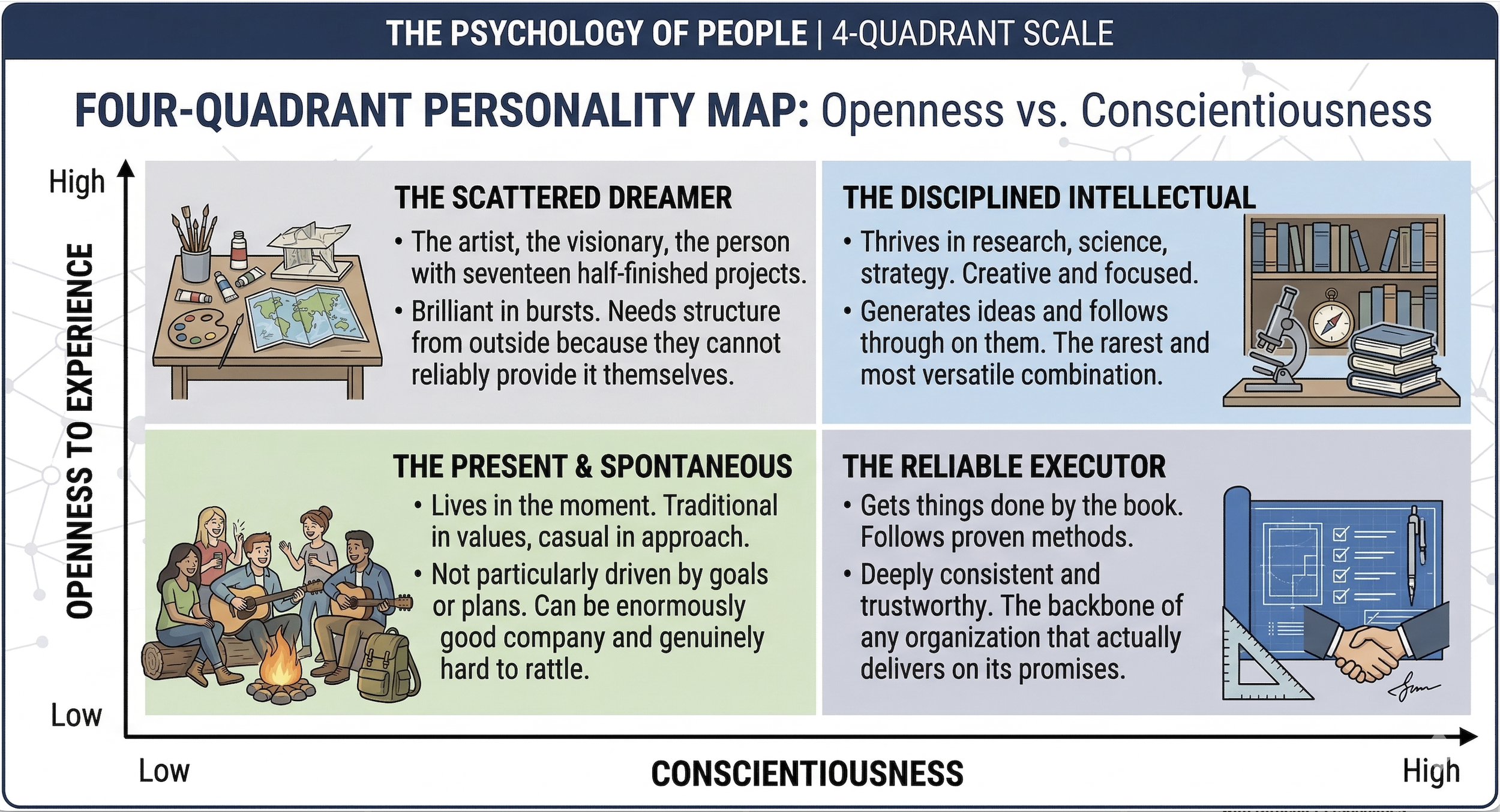
Don't try to understand personality from a single trait. What matters is the interaction, the combination. This chart is just a taste of how much richer the picture becomes when you start combining dimensions to properly build a personality description.
Conscientiousness at Work
Roles that naturally attract and reward high Conscientiousness include law, accounting, banking, surgery, compliance, air traffic control, and project management — anywhere the cost of an error is high and the value of meticulous consistency is enormous.
High-Conscientiousness people thrive when everything is in its place: clear agendas, punctual time frames, the ability to finish tasks sequentially before moving to the next. They find chaos genuinely distressing.
Low-Conscientiousness people often work surprisingly well in environments that would destabilize their more organized counterparts. Clutter doesn't bother them. Open loops are fine and flexibility comes naturally to them. The challenge comes when they are placed in highly regimented environments or when execution is the entire job.
Be sure the right person is matched to the right job.
Influencing Someone High in Conscientiousness
Walk into a meeting with a high-Conscientiousness person unprepared and you've already lost. They will notice. They will judge. And they will spend the rest of the meeting deciding whether you're worth their time.
Set a clear agenda and share it in advance.
Be punctual. If you're going to be late, say so well ahead of time.
Identify their areas of achievement and relate to them; their track record, their field, their standards.
Emphasize that they are in control and that this is their decision to make.
A few influence principles work particularly well with this personality type. Authority lands strongly. If an expert, a respected institution, or an established body of research supports your position, lead with that. It carries real weight with someone who respects credentials and track records.
Reciprocity works too, if you have done something for this person, they will feel a genuine pull to return it. They keep score, not out of calculation, but out of a deep sense of fairness.
Perhaps the most powerful lever of all is consistency, the human tendency to want to stay aligned with what we've previously said and done. Conscientious people pride themselves on being people of their word. If you can get them to articulate a position, a value, or a preference early in the conversation, they will feel an almost moral obligation to stay true to it later. A simple question like "what matters most to you in a deal like this?" asked early and then referenced later, can be remarkably effective. This acts as an anchor that helps them feel the decision is consistent with who they already are.
One specific risk to manage: High achievers want to achieve. They want to close a deal and move on to the next one. If you want to avoid the individual jumping to a conclusion that won’t benefit you simply in order to close the deal, state a structured timeline in advance. For example, say something to the effect of 'Today we open the topic, and we’ll reconvene on Thursday to make a decision.' This gives them the closure structure they need while preventing a premature decision that doesn't serve you.
Influencing Someone Low in Conscientiousness
Don't push your agenda. Provide a framework and let them find their way to a decision.
Help them map out what they need in order to decide. They may not have done this themselves.
Emphasize your flexibility. Be patient with timing.
Be spontaneous. Rigidity will feel oppressive to them.
Position yourself as a consultant or adviser, there to help, not to direct.
Getting the yes may be the easy part. Think through how to support the follow-through, because that's where this personality can struggle.
High Conscientiousness Under Pressure
Here's a counterintuitive finding worth knowing: people high in Conscientiousness can actually perform worse during periods of extreme stress. Their orientation toward doing things right, toward meeting standards and following process, can become paralyzing when the situation is too chaotic for any process to fit. They are built for steady, organized environments, and when those conditions are stripped away, they can become rigid or shut down in ways their less conscientious colleagues don't.
Knowing this is useful if you're managing someone highly conscientious through a crisis: they need structure more than ever during a crisis, with clear goals and ways to reach them.
A Research Note: Personality and Eyewitness Memory
A 2025 study by Hagsand & Compo examined how personality affects eyewitness recall under intoxication — and the findings are striking. As intoxication increased, people high in Openness continued to remember more details, possibly because their natural presence and absorption in the moment held even when impaired. People high in Conscientiousness, by contrast, reported fewer details the more intoxicated they became — not because they remembered less, but apparently because they became more cautious about what they were willing to report. The drunker they felt, the more carefully they gatekept their own recall.
The implications for witness interviewing, legal proceedings, and the intersection of personality with evidence are significant. We'll return to this in the litigation section.
(Hagsand, Angelica & Compo, Nadja. (2025). The big five traits openness and conscientiousness affect the memory of alcohol-intoxicated eyewitnesses. Journal of Memory and Language. 140. 10.1016/j.jml.2024.104579. )
YOUR PRACTICAL TAKEAWAYS
The next time someone misses a deadline or appears disorganized, ask yourself: is this low Conscientiousness, or is something else going on? Low Conscientiousness isn't laziness, it's a different relationship with structure. (Note: that doesn’t mean they can get away with it, but it means you change how you communicate that need to them).
Before a negotiation, figure out which quadrant of the 2x2 your counterpart occupies. Are they a Disciplined Intellectual? A Reliable Executor? A Scattered Dreamer? Each requires a different approach.
If you are high in Conscientiousness: watch for the premature closure trap. Your drive to settle things can push you to lock in before you should. Build in deliberate pauses.
If you are low in Conscientiousness: identify one external structure — a person, a system, a deadline — that can help you bridge the gap between your ideas and their execution.
COMING UP NEXT
Next: Extraversion, the most visible of the Big Five, and one of the most misunderstood. We'll look at what introversion and extraversion really mean, why high-pressure sales tactics backfire catastrophically with introverts, and how to choose the right environment for any negotiation.